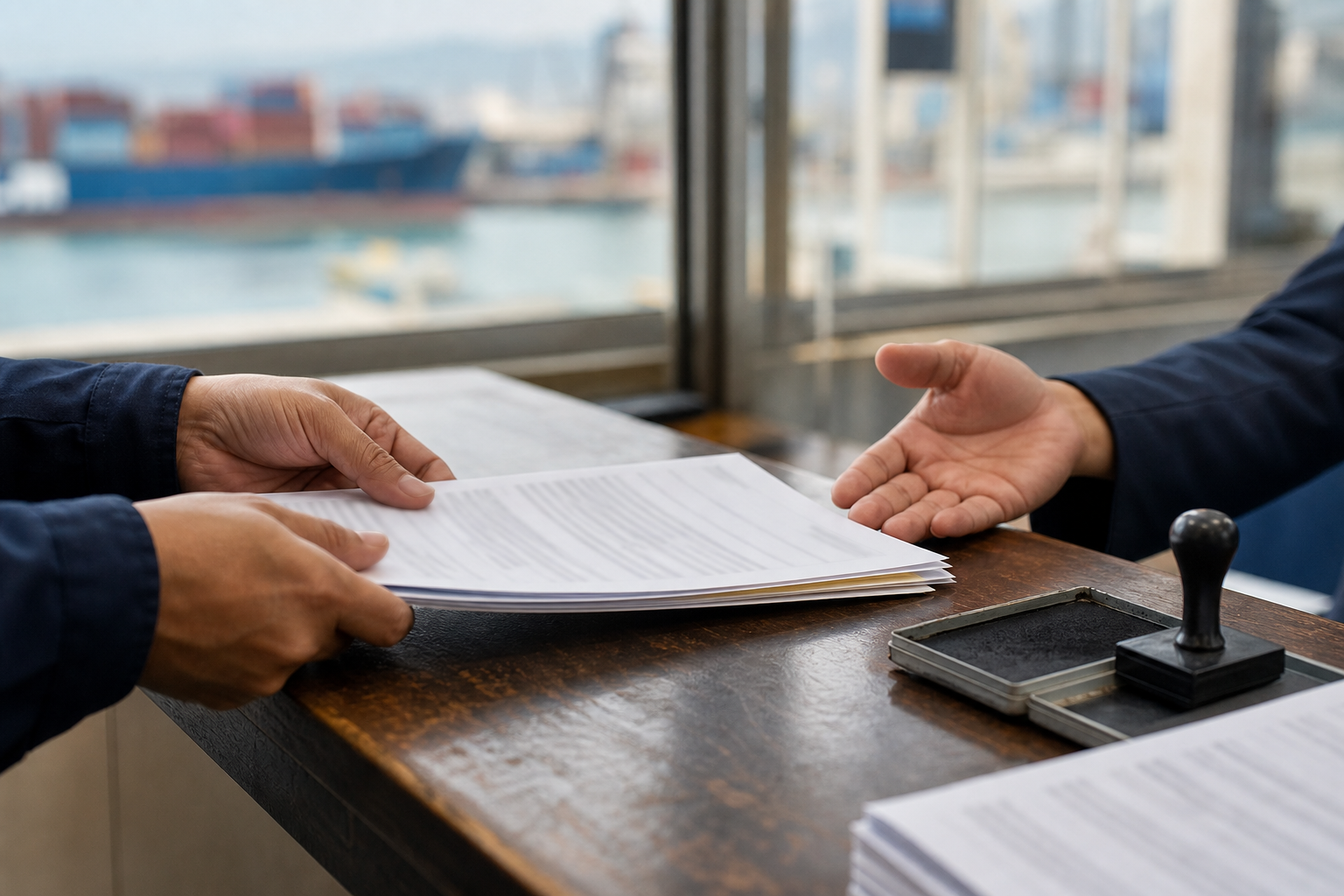
Three ways to release the same container
Three identical containers can leave the same berth under the same contract and be collected three different ways at the other end. What separates them is a choice made at booking — long before anyone stands at a counter asking for the cargo.
A telex release is arranged with the ocean carrier at origin: the shipper pays the freight, surrenders the full set of original bills of lading to the carrier's office at the load port, and signs the carrier's surrender request. The carrier then instructs its destination office to release the cargo to the named consignee without any original being presented.
The three routes are an original bill of lading, a telex release, and a sea waybill. They differ in one thing above all: whether a document of title exists, and if so, where it is sitting. This guide covers what each one means, how to request a telex release, and which one a bank will accept. It does not compare sea and air transport documents — bill of lading vs air waybill covers that.
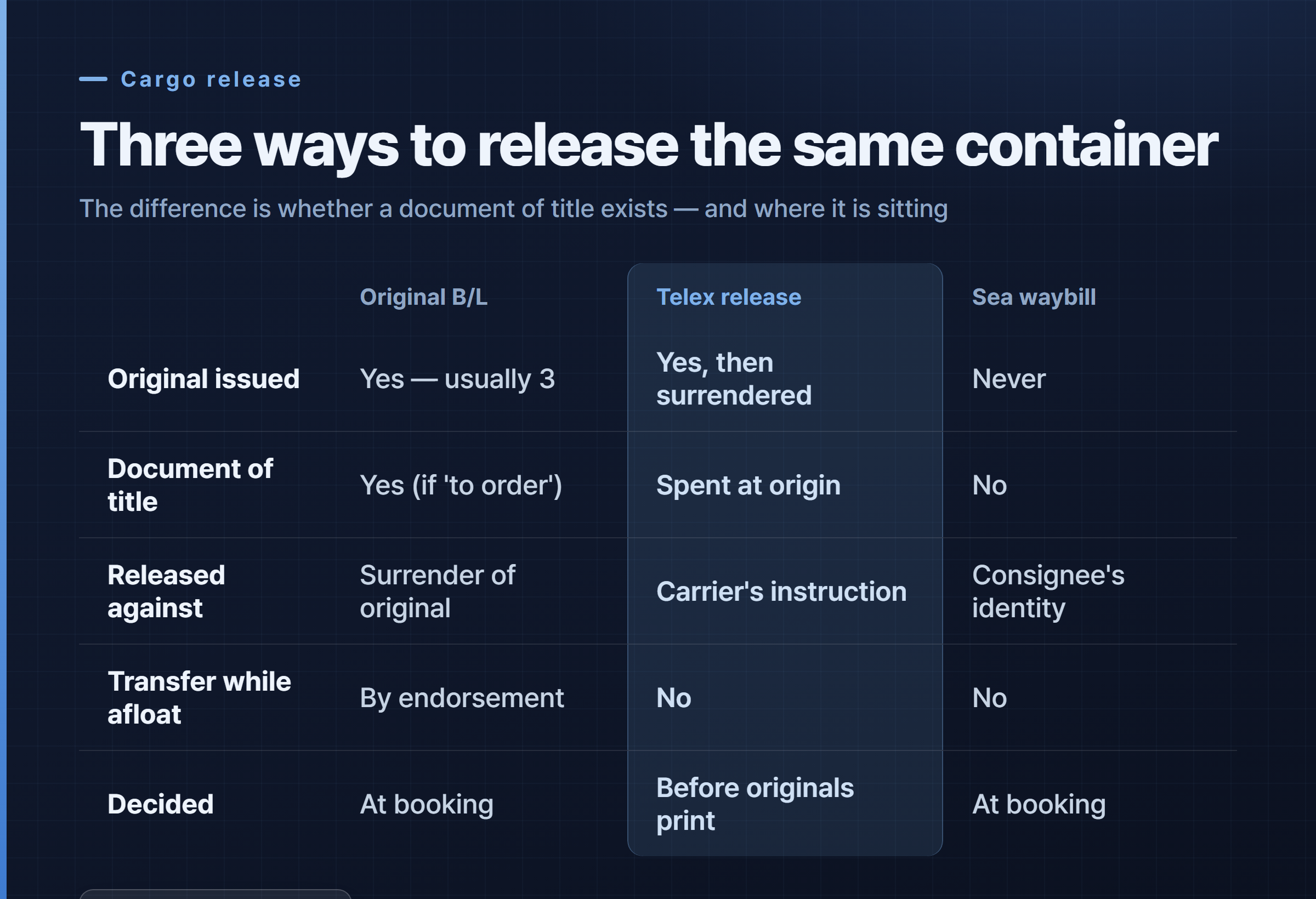
What is a telex release, and what is a sea waybill?
The two are routinely used as though they were the same arrangement. They are not, and the difference decides what your buyer can do with the shipment while it is afloat.
A telex release is a carrier's instruction to its destination office to hand over the cargo because the original bills of lading have already been surrendered at origin. An original was printed and issued — it simply no longer travels with the deal. The title document existed, and it was given back.
A sea waybill is a non-negotiable transport document under which no original document of title is issued at all. The carrier names a consignee on the face of it and releases the cargo to that party on proof of identity. Nothing can be endorsed, because there is nothing to endorse.
Everything downstream follows from that single line. Where originals existed, a paper trail of title exists too, and the carrier can show that the shipper released it. With a sea waybill there was never any title to move, so the consignee named at booking is the consignee who collects — changing that means instructing the carrier to amend the document before delivery, not endorsing it to someone else.
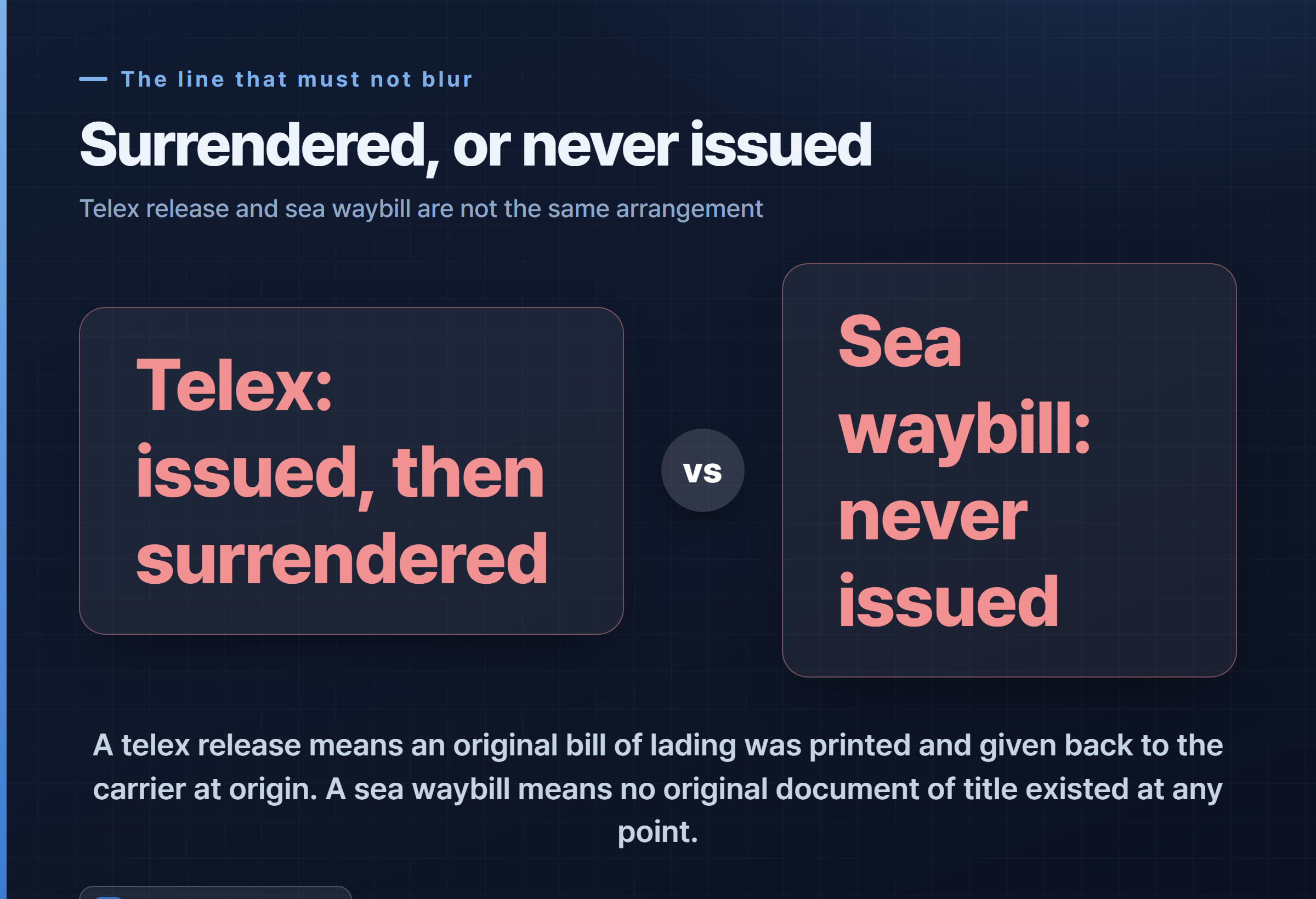
The line that must not blur
A telex release means an original was issued and then surrendered. A sea waybill means no original was ever issued. Everything else about the two follows from that.
How do you get a telex release?
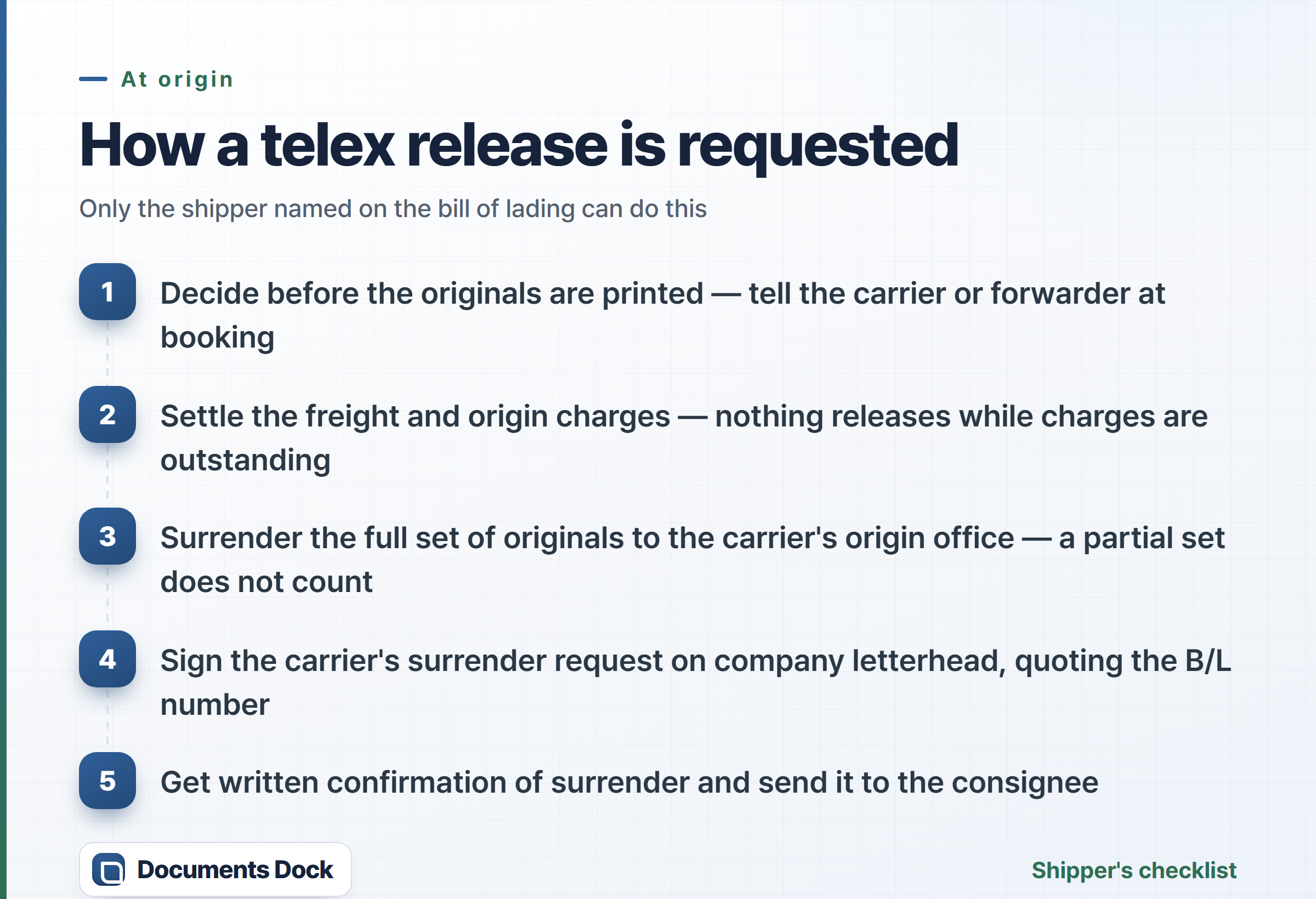
A telex release is requested by the shipper — the party named as shipper on the bill of lading — not by the consignee. The carrier acts on the instruction of whoever holds the contract of carriage, so a buyer who wants one has to ask the seller to arrange it.
The sequence at origin is short, but each step gates the next.
- Decide before the originals are printed — tell the carrier or forwarder at booking, or at the latest before the bill of lading is released, that the shipment is to be surrendered at origin
- Settle the freight and origin charges — carriers will not release cargo, by telex or otherwise, while charges are outstanding
- Surrender the full set of originals — where originals were issued, usually three, every one goes back to the carrier's origin office; a partial surrender does not count
- Sign the carrier's surrender request — most carriers want it on the shipper's letterhead, signed and stamped, quoting the bill of lading number
- Get the confirmation in writing — ask for the carrier's written confirmation that the B/L is surrendered at origin, and pass it to the consignee with the arrival documents
The consignee cannot self-serve
Only the shipper on the bill of lading can surrender it. If the supplier has not arranged the release, no amount of asking at the destination counter will produce one.
What if the originals have already been couriered?
This is where the request usually goes wrong. Once the originals have left the shipper's hands, a telex release is still possible, but it now depends on getting every one of them back.
The full set has to be retrieved from wherever it went — the consignee, a bank, a forwarder — and surrendered to the carrier at origin. If a bank is holding the set as security under a documentary credit, it will not hand it over simply because the cargo has arrived. Holding it is the point.
Where the cargo will land before the originals can be recovered, the carrier may agree to release against a letter of indemnity, usually countersigned by a bank. A letter of indemnity is not a telex release and not a substitute document of title — it is a promise to compensate the carrier if releasing cargo without an original turns out to have been wrong. Carriers accept one at their discretion, and banks charge for countersigning.
The practical fix is upstream: settle the release method when the booking is made. What actually lands at the other end, and what the consignee should check before paying anything, is covered in what to check on an arrival notice.
Which release method will your letter of credit accept?
That depends on what the credit asks for, and the two documents are governed by different articles. Under UCP 600, Article 20 sets the requirements for a bill of lading and Article 21 for a non-negotiable sea waybill. A credit calling for one will be examined against that article, and presenting the other is a discrepancy.
The trap is the phrase "full set of originals." Article 20 requires a presented bill of lading to be the sole original or, where more than one was issued, the full set as indicated on the document itself. Originals surrendered for a telex release cannot be presented at all — so a telex-released shipment cannot satisfy a credit written that way.
Where the credit calls for a non-negotiable sea waybill instead, a sea waybill is exactly what the bank expects, and the shipment moves without originals from the start. The decision therefore belongs at the point the credit is agreed, not at the point of shipment. Banks have a maximum of five banking days following presentation to examine documents under Article 14(b) — time you would rather not spend on a mismatch that a phone call at booking would have prevented.
Discrepancies of this kind are hard to argue away, because they are structural rather than typographical: nothing is misspelled, the required document simply does not exist. How a letter of credit discrepancy plays out follows one through.
Match the transport document to the credit
Ask which article the credit is written to before you book. Changing the release method after the credit is issued means amending the credit, with the buyer's and the issuing bank's agreement.
Do you still need an original bill of lading?
An original bill of lading earns its cost when someone needs to hold or transfer control of the cargo while it is in transit — an unpaid seller, a financing bank, or a trader who intends to sell the goods afloat. Where none of those apply, the original mostly adds courier time and the risk of arriving late.
The case for keeping originals is control. Until the buyer pays, or meets the terms of the credit, the seller or the bank holds the one document the cargo will not be released without. The case against them is friction: printing, couriering, chasing, and the standing possibility that the set reaches the destination after the vessel does.
Repeat business between a known buyer and seller on open account is where sea waybills and telex releases sit most naturally. Originals stay with credit-backed, financed, and first-time transactions, where the security they provide is the whole reason the document is being used.
- Payment secured by a documentary credit, or the goods financed — original B/L, full set, under bank control
- Goods may be sold or the consignee changed while afloat — original "to order" B/L; only an endorsable document transfers
- Known buyer, open account, or payment received before arrival — sea waybill, decided at booking, no originals printed
- Originals already issued but payment settled and the vessel due — telex release; surrender the full set at origin
- Cargo landed, originals unavailable, no other route — letter of indemnity at the carrier's discretion; treat it as the exception
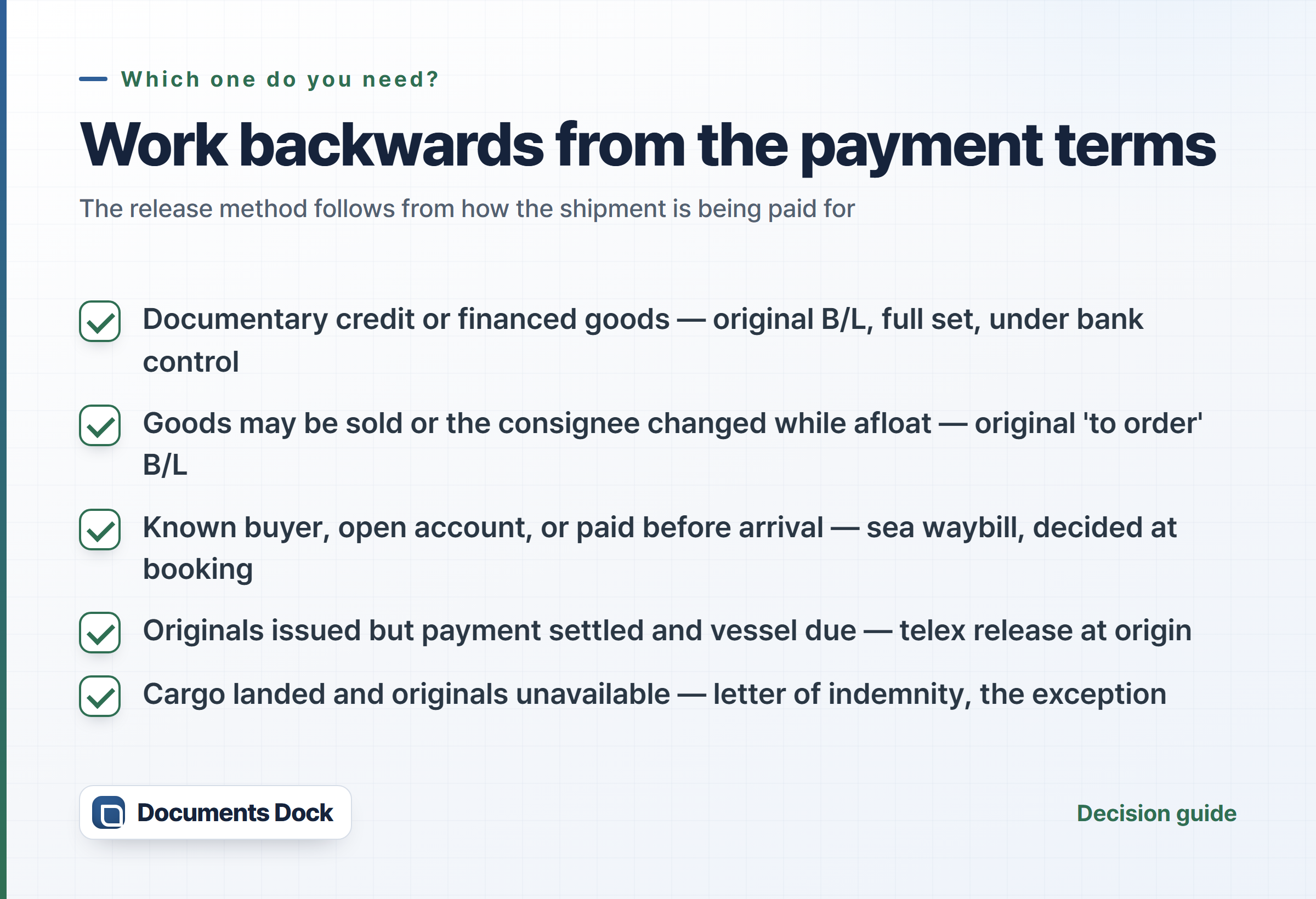
Where the release method sits in your document set
The release method is not an extra document. It is a property of the transport document you were always going to have — chosen at booking, and shown on the bill of lading itself once it is issued as surrendered.
Which means the work is upstream. Agree the method with the buyer, match it to the payment terms, tell the carrier before the originals are printed, and keep the carrier's surrender confirmation filed with the rest of the shipment's papers. Where the transport document fits alongside everything else is set out in getting your export document set in order.
Documents Dock builds the per-recipient bundle — carrier, bank, broker, buyer — from one shipment record, so the transport document each of them receives is the right one, with the surrender confirmation filed beside it. Keep the set in one place at documentsdock.com.
This is general information, not legal or banking advice. Release practice varies by carrier, trade lane, and the terms of your sale and payment — confirm the arrangement with your carrier or freight forwarder, and with your bank where a documentary credit is involved, before you book.
Sources
International Chamber of Commerce (ICC) — Uniform Customs and Practice for Documentary Credits (UCP 600), Articles 14, 20 and 21 (iccwbo.org). Comité Maritime International — CMI Uniform Rules for Sea Waybills (comitemaritime.org). U.S. International Trade Administration (trade.gov) — transport and shipping documents.